

English translation of an article by Roberto Iannuzzi, originally published in Italian on his Substack.
On April 8, the day after a ceasefire with Iran (which was supposed to include Lebanon) came into effect, Beirut was hit by an extremely violent Israeli bombardment.
Within minutes, entire residential buildings had been reduced to rubble — smoking heaps of concrete and twisted metal. Dozens of Israeli aircraft dropped bombs and missiles on around a hundred targets in the capital and other parts of the small neighbouring country.
The initial toll announced by Lebanon’s Ministry of Health was devastating: more than 350 dead and over 1,200 wounded. In the capital, the strikes hit residential neighbourhoods and some of the most crowded commercial streets.
“Eternal Darkness” is the emblematic name Israel gave the operation, as if signalling an intent to bring about the total annihilation of its neighbour.
In the wake of Hamas’s October 7, 2023 attack, the Israeli government led by Prime Minister Benjamin Netanyahu had unleashed a campaign of unprecedented violence against the Gaza Strip — supported by a massive flow of US weapons — pulverising residential areas and civilian infrastructure.
In Lebanon, Israeli forces have adopted the same tactics: massive air bombardments and sweeping, arbitrary evacuation orders that have forced hundreds of thousands of people into displacement.
Civilian infrastructure, villages, and border towns have been razed to the ground to make way for “buffer zones” occupied by Israeli forces. Hospitals, medical personnel, rescue workers and journalists have been targeted — all in an atmosphere of substantial international indifference and apathy.
A Ceasefire Never Respected
The fragile ceasefire reached with Hezbollah at the end of 2024 was violated repeatedly by Israel, which struck various parts of Lebanon on multiple occasions, killing at least 370 people.
In the meantime, the American administration had been pressing the Lebanese government to proceed with Hezbollah’s disarmament, while Israel continued to bomb the country. This only served to heighten tensions within Lebanon.
Although it did not respond to Israeli violations, Hezbollah carried out a gradual rearmament.
Only after the Israeli assassination of Iranian Supreme Leader Ali Khamenei on February 28 did Tehran’s allied group respond with a rocket launch against Israel — one that the BBC itself described as “largely symbolic”.
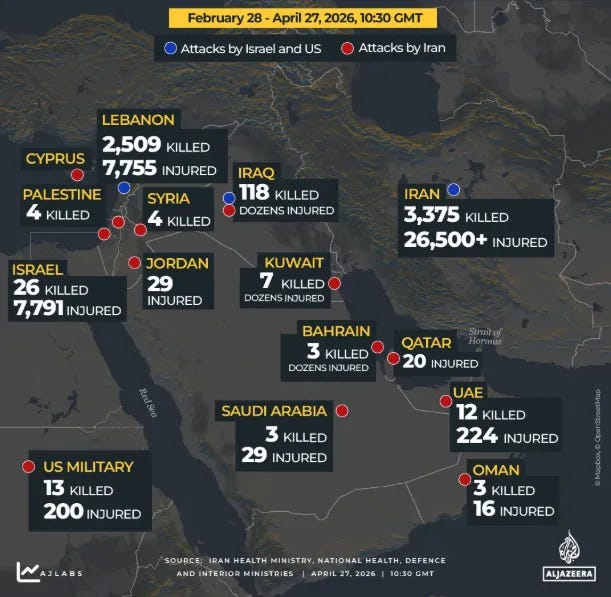
This gave Tel Aviv the pretext to launch the large-scale operation described above, which since early March has caused more than 2,500 deaths and nearly 8,000 injuries.
At the start of the campaign, senior Israeli officials declared that Lebanon would receive the same treatment as Gaza.
Finance Minister Bezalel Smotrich, for his part, stated that Beirut’s southern suburbs would soon resemble Khan Younis — the city in southern Gaza utterly razed to the ground by more than two years of bombardment.
Verbal Violence and War Crimes
Similar scorched-earth tactics were adopted by the United States and Israel in their war of aggression against Iran, accompanied by official statements of equally stark violence.
At a Pentagon press conference on March 4, Secretary of War Pete Hegseth declared that the campaign against Iran had never been “meant to be a fair fight, and it is not a fair fight. We are punching them while they’re down, which is exactly how it should be”.
He added that the United States would be raining “death and destruction from the sky all day long” and that the war was being waged “devastatingly, decisively, and without mercy”.
A few days earlier, presiding over his first Pentagon worship service since the start of the war, Hegseth had prayed for “overwhelming violence of action against those who deserve no mercy”.
For his part, President Donald Trump repeatedly threatened to blow up Iran’s power plants, bridges and desalination facilities, to “decimate“ its infrastructure and to send Iran “back to the Stone Age”.
These threats culminated in the April 7 ultimatum, when he warned that “an entire civilization will die tonight, never to be revived”, if Iran did not agree to reopen the Strait of Hormuz.
Such violence is not merely rhetorical — it finds full expression in the military campaign waged against Iran.
The Iranian Red Crescent Society (IRCS) has recently submitted to the International Criminal Court and other international bodies the evidence it has gathered on possible war crimes committed by the US and Israel since the start of the bombardments on February 28.
The IRCS estimates that the Israeli-American strikes destroyed more than 132,000 civilian structures, including residential homes, hospitals, schools, universities, research institutes and bridges.
On the first day of the conflict, the United States bombed the elementary school of Minab, in southern Iran. It was hit twice, forty minutes apart, maximising the number of victims — 155 children and 26 teachers.
The violence of the Israeli-American campaign was such that even the British Telegraph described Tehran as “an apocalypse of burning hospitals and children buried under rubble”.
The provisional toll stands at at least 3,375 dead and over 26,000 wounded. It is worth noting that Iran’s retaliatory action in the Gulf, though it caused considerable damage to military and energy infrastructure, resulted in only a few dozen deaths.
The Israeli campaign against Lebanon (which caused more than 2,500 deaths) was, proportionally, even more ferocious than the Israeli-American campaign in Iran.
More Permissive Rules of Engagement
It is equally important to stress that the overwhelming violence of these military operations cannot be attributed exclusively to the current governments in the United States and Israel — it must be understood in the context of a broader transformation in the military culture of the two countries.
Naz Modirzadeh, a professor at Harvard Law School and founder of the university’s program on international law and armed conflict, described it as reflective of a “deeper transformations within the US military and its legal apparatus”.
As I wrote in an article about a year ago:
In recent years, the Department of Defense has become increasingly focused on how the US might fight a large-scale conflict against an adversary capable of matching the American military in technology and force. In such a scenario — referred to in technical jargon as a “large-scale combat operation” (LSCO) — an extremely violent military confrontation would unfold across multiple domains (air, land, sea), air superiority would not be guaranteed, casualties would run into the hundreds of thousands and entire cities would be razed to the ground.
“In short”, Modirzadeh argues, the US military has begun “preparing for an all-out war with China”. With a conflagration of such magnitude in mind, military legal experts are reinterpreting the laws of war.
In 2021, an article in Military Review, authored by two senior US Army legal experts, argued that the US would need to fight on the basis of far more permissive rules if it hoped to win a large-scale war. Further articles in the same vein followed.
Geoffrey Corn, a professor of law at Texas Tech University and former senior legal adviser to the US armed forces on the laws of war, assessing Israel’s military conduct in Gaza, argued that “the systems and processes that the IDF implemented are very similar to what we would implement in a similar battle space”.
Corn had made these statements to the American magazine The New Yorker.
The same report states that the idea “that Israel’s conduct in Gaza is in line with the US military’s understanding of its own legal obligations, has become the general consensus among American military lawyers and their allies in the academy in recent years”.
The “Dahiya Doctrine”
The military tactics adopted by Israel in Gaza in turn derive from the war fought by the Israeli army against Hezbollah in 2006.
It was then that the Israeli armed forces elaborated what became known as the “Dahiya doctrine”, named after the southern suburb of Beirut — generally considered Hezbollah’s “stronghold” but simultaneously home to thousands of Shia civilians who have no necessary connection to the organisation.
The doctrine, conceived by General Gadi Eisenkot, then head of the IDF’s Northern Command, entails the deliberate destruction of civilian infrastructure as a method of collective punishment, designed to turn the local population against the military entity controlling that territory.
Eisenkot subsequently declared: “What happened in the Dahiya quarter of Beirut in 2006 will happen in every village from which Israel is fired on… We will apply disproportionate force on it and cause great damage and destruction there. From our standpoint, these are not civilian villages, they are military bases… This is not a recommendation. This is a plan. And it has been approved”.
Israel is once again applying this tactic in Lebanon where, despite the new ceasefire, it continues to level villages and civilian infrastructure — often through outright controlled demolitions.
It is estimated that since early March, Israeli forces have destroyed or damaged more than 62,000 residential units across the country. The objective is to create a permanent buffer zone that definitively prevents residents from returning.
In late March, Israeli Defence Minister Israel Katz declared that the 600,000 Lebanese living south of the Litani River — situated roughly 30 kilometres from the border with Israel — would never be allowed to return, and that their homes would be destroyed.
Permanent State of War
From a strategic standpoint, Israel has embraced what some have called the doctrine of “permanent security” and others that of “preventive war”, in opposition to the theory of containment previously adopted by the Jewish state.
Whatever one chooses to call it, this approach envisages no negotiated resolution to conflicts, only a military solution pursued through the massive use of force. In practice, this doctrine translates into a permanent war encompassing not only Gaza and the West Bank, but also Lebanon, Syria, Iraq, Yemen and Iran — what many in Israel have termed the “war on seven fronts”.
This campaign involves a total disregard for international law, rules out any political compromise and aims exclusively at the elimination of the adversary — through the decapitation of its political and military leadership or annihilation via overwhelming military superiority.
But the conflict with Iran, which rapidly spiralled into a regional war, has exposed all the limitations of this theory.
The resort to targeted killings, and to exorbitant levels of violence and destruction, has failed to bring about the collapse of the Islamic Republic in Iran or of Hezbollah in Lebanon. Even Hamas remains in power in the devastated Gaza Strip.
For its part, Israel has been ground down by over two years of uninterrupted conflict. Its army is worn out by casualties of men and materiel, by the constant mobilisation of reservists and by the need to fight on multiple fronts.
The United States has squandered enormous quantities of armaments and strained the logistical capabilities of its navy and air force, only to find itself ultimately compelled to evacuate its bases in the Arabian Peninsula.
Washington has lost control of the Persian Gulf and must now contend with the global crisis triggered by Iran’s closure of the Strait of Hormuz.
Both the US and Israel find themselves in an unprecedented strategic, political, and moral paralysis. The temptation to resort to ever greater levels of ferocity and violence as a way out of the impasse — if heeded — is destined to drag them both deeper into an abyss into which they risk pulling the region and the world.
Thanks for reading. Putting out high-quality journalism requires constant research, most of which goes unpaid, so if you appreciate my writing please consider upgrading to a paid subscription if you haven’t already. Aside from a fuzzy feeling inside of you, you’ll get access to exclusive articles and commentary.
Thomas Fazi
Website: thomasfazi.net
Twitter: @battleforeurope
Latest book: The Covid Consensus: The Global Assault on Democracy and the Poor—A Critique from the Left (co-authored with Toby Green)
The reversal will come from China. There is more respect for humanity in the east than from the west. I can see the bottom. It was the resolute Vietnamese that showed the way of it.
It works.