

I’ve written for Compact about why Icelanders rejected their government’s proposal to reopen accession negotiations with the EU — and why that’s great news for Iceland. A slightly different version was also published in the German magazine NachDenkSeiten. Here’s an excerpt:
Icelanders were being asked to cede control over their fisheries, their agriculture, and their trade policy to Brussels, and—since no state acceding after Maastricht holds Denmark’s opt-out—agreeing in principle to adopt the euro. Sweden has demonstrated that this obligation can be deferred more or less indefinitely, but indefinite deferral at the sufferance of the institutions is not the same thing as a right of refusal.
In addition to a seat at the table—to be exact, six seats out of 720 in the European Parliament and one voice among twenty-eight in the Council—Iceland would have received (possibly) marginally cheaper imports and a little more tourism, all while becoming a net contributor to the EU budget.
But the deeper problem with the pro-EU argument is that it treats the bloc as though it were little more than a very large trade agreement—a body of technical standards governing the labelling of jam and size of fruits, to which membership would simply add a vote. But the European Union is much more than this: it is a political, institutional and ideological mega-machine, and its power over member states goes well beyond the percentage of directives transposed. As we saw in the wake of the financial crisis, countries that join effectively adopt an “economic constitution” that binds them to a ruthlessly enforced neoliberal framework that no democratic vote can override. This is particularly evident for eurozone countries.
[…]
Indeed, the island nation already made the argument against EU membership better than any article could. When the financial crisis struck in 2008, Iceland was hit harder than almost any country in Europe. Ninety percent of its banking system collapsed. Yet it recovered faster and better than virtually all of them. Why? Because it had something eurozone countries had surrendered: sovereignty. Iceland could let its currency adjust; it could let its banks fail rather than being forced by the European Central Bank to bail them out at the expense of its citizens; it could impose capital controls on its own authority and lift them on its own timetable—which it did, fully, only in 2017. It could also ask its own people what they wanted: in the Icesave referendums of 2010 and 2011, Icelanders refused to shoulder the private debts of failed bankers.
Compare that with the fates of Greece, Ireland, Portugal, and my own country, Italy: countries that, trapped in the eurozone, were subjected to years of punishing austerity, mass unemployment, and social devastation, administered by unelected technocrats in Brussels and Frankfurt. Iceland weathered the storm because it was a much freer country. That was the lesson of 2008, and it remains truer than ever today.
[…]
Becoming an EU member would have been a bad idea twenty or thirty years ago, but it would be an even worse one now. Today, the bloc’s oligarchic machinery—the austerity, the technocracy, the contempt for democracy—has mutated into a full-blown war machine. The EU has launched a $927 million rearmament program, “ReArm Europe”, hastily rebranded “Readiness 2030”, on top of national commitments agreed at NATO’s Hague summit to raise military spending to 5 percent of GDP. Manfred Weber, leader of the largest group in the European Parliament, speaks openly of $7 trillion in European military spending over the coming decade, and insists that this build-up must be locked in so that, in his own words, no future government can undo it.
How will all this be paid for? The Financial Times said the quiet part out loud: Europe must trim its welfare state to build a warfare state. One might object that Iceland already belongs to NATO and cannot avoid this fate in any case. But Iceland has been in the alliance since 1949, and still has no standing army: seventy-seven years of membership, not one Icelandic soldier. NATO has few means of actually forcing a country to follow its diktats. Joining the EU is another matter. It means handing full control of your economy to what has effectively become the political arm of NATO—one that will use every tool at its disposal to bring member states into line with the EU-NATO strategy.
Read the whole article here. Help me share it on X.

Thanks for reading. Putting out high-quality journalism requires constant research, most of which goes unpaid, so if you appreciate my writing please consider upgrading to a paid subscription if you haven’t already. Aside from a fuzzy feeling inside of you, you’ll get access to exclusive articles and commentary.
Thomas Fazi
Website: thomasfazi.net
Twitter: @battleforeurope
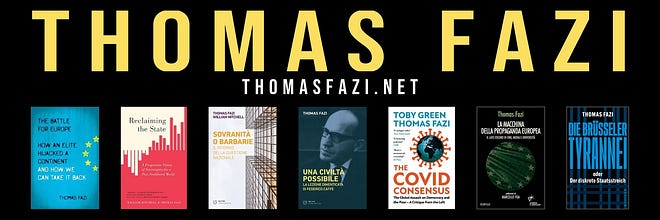
Latest book: The Covid Consensus: The Global Assault on Democracy and the Poor—A Critique from the Left (co-authored with Toby Green)
“Icelanders were offered a chair at the negotiating table. They looked at it. And decided they were perfectly comfortable standing.” Íris Erlingsdóttir – August 31, 2026
https://europeanconservative.com/articles/analysis/when-iceland-said-no-to-brussels/
IMPERIALIST EU AGAINST THE WORKERS OF THE WORLD
The NO vote rejecting joining the EU by Icelanders was a good thing for working people in Iceland, Africa, Asia and Latin America. The EU imperialist bloc is an economic and military weapon of the capitalist rulers of Europe aimed against all working people.
It's the opposite of solidarity. It's Fortress Europe against all working people. The humanitarian blather is nothing more than window-dressing for cold-blooded bankers.
The predatory and protectionist EU through unequal and unfair trade and dumping is absolutely devastating the economies of Africa, Asia and Latin America, increasing unemployment and driving farmers off their land, forcing millions to migrate. The EU is no different from US imperialism and the other great powers that are immiserating billions of workers and farmers in Africa, Asia and Latin America, and within their own countries. The greedy insatiable capitalists are devastating the lives of all working people everywhere.
Working class Icelanders don't trust the EU, and they are right to reject it.
Iceland was militarily invaded against their will by the UK and United States during WWII. The US set up a massive military base, Keflavik, closed it and then reopened it, only to have the Icelandic people demand the US military leave. Good riddance.
Iceland was forced into NATO. The Icelandic people had no say at all. There was no referendum. On March 30, 1949, the Althing (Iceland's parliament) voted to join NATO by only 37 dirty politicians —37-13. NATO conquered Iceland with just 37 bought and paid for votes!
On the day of the vote, massive protests erupted outside the parliament building in Reykjavik. This escalated into the historic 1949 anti-NATO riot, where rocks were thrown at the building, windows were smashed, and police deployed tear gas to disperse the crowds.
Imperialist trade and military blocs are death traps for working people. They aim to divide and pit us against our fellow workers. What working people need is unity and a just world, not to support one group of capitalists in their cruel wars for greater profits against their rivals.
Today the imperialist rulers in the EU are engaging in a massive military buildup and a nuclear arms race. They are demanding the working class “sacrifice” for their bloody wars.
The capitalist rulers of Europe correctly recognize that the historic crisis of capitalism is intensifying competition over profits to the point where another inter-imperialist world war is now inevitable. Declining US imperialism will go to war against its rival Chinese imperialism. The European imperialists are determined to grab what they consider “theirs” in the coming wars to divvy up the world into turfs; and just like the US rulers they are preparing to kill millions once again for their profits.
The world working class is one, and we must reach out to our fellow workers around the world to join together to bring the capitalist nightmare to an end before they kill us. The EU and all such blocs are a barrier to our unity.