

I’m delighted to announce the upcoming publication of my new book, The Brussels Empire: The EU’s Secret Coup Against Democracy, which I consider to be the ultimate distillation my decade-and-a-half of work on the EU. The book will be published in late October by the wonderful German publishing house Westend — and for now will be available only in German.
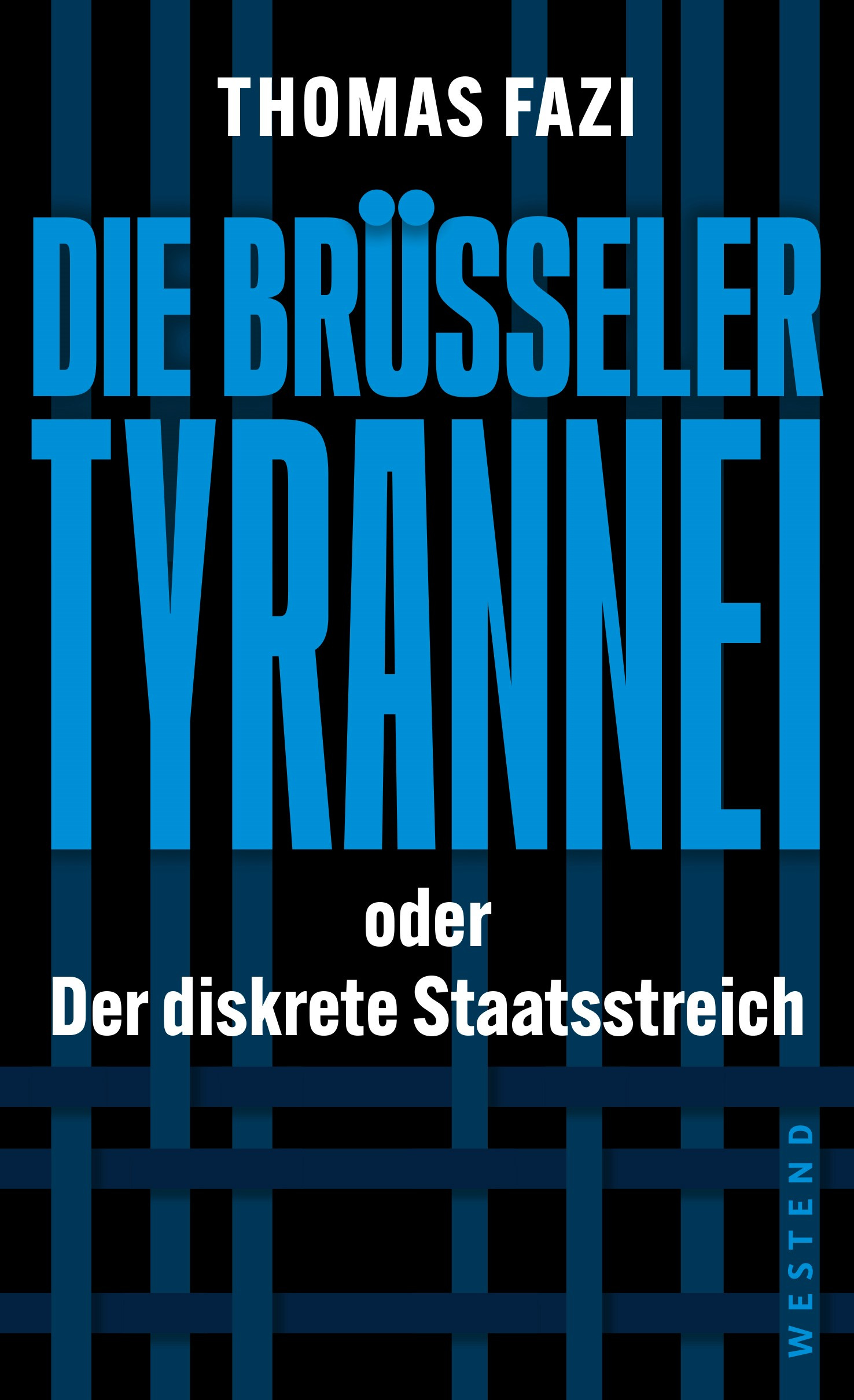
I’m still looking for an English-language publisher so if you know any publishers who are interested in EU- and NATO-critical views, let me know 🙂
I just received this great quote from renowned German sociologist Wolfgang Streeck:
As an independent journalist, Thomas Fazi is one of the most knowledgeable and astute observers of the European Union. Fazi is able to identify and explain developments and interconnections that the conventional wisdom of academic EU research — largely funded by the very entity it studies — refuses to even consider. Unlike that approach, Fazi’s new book treats the EU and its functions within the European state system not in a technocratic manner, but rather from a political perspective. It shows just how far the EU has already succeeded in eroding the sovereignty of its member states — and, with it, their democratic potential.
Here is a detailed summary of the book:
The European Union (EU) was founded on promises of peace, freedom, prosperity and strategic autonomy. What does it stand for today? War, censorship, authoritarianism, economic stagnation, if not outright deindustrialisation, and geopolitical vassalisation to Washington’s diktats.
The EU has not merely failed economically, falling steadily behind the world’s other major advanced economies. Far more troubling, it has mutated into a quasi-dictatorial, pseudo-imperial power — one that sets the terms on which 450 million people work, trade, consume and invest; that continues to dismantle Europe’s welfare states in the name of austerity; that financially coerces entire states into compliance; that overturns national laws and constitutions at will; that runs multi-billion-euro propaganda operations and engages in widespread online censorship; that interferes directly in national elections (Romania, Hungary, etc.); and that extra-judicially sanctions its own citizens, stripping them of basic civil rights. All of this, while remaining almost entirely insulated from democratic pressure and largely beyond the control of the governments that nominally constitute it.
This is the product of a long process of creeping “Commissionisation” and supranationalisation of Europe’s decision-making process. Over the past decade, the EU’s institutional centre of gravity has shifted decisively towards the European Commission, which has steadily colonised policy areas once reserved for national governments — fiscal policy, public health, foreign affairs, defence. The mechanism has been remarkably consistent: each successive crisis — the sovereign debt crisis, Brexit, the Covid-19 pandemic, the war in Ukraine — has served as a pretext for the Commission to assume new powers, issue “emergency” decisions and quietly lock in permanent shifts in the architecture of EU authority. None of this has required formal treaty change. It has happened by stealth, outside the arena of public debate, through what scholars term “integration by stealth” — and the result has been a steady, cumulative erosion of national sovereignty and democratic accountability. Even former European Council President Charles Michel recently accused von der Leyen of creating “a super-authoritarian governance”.
To compound matters, the EU now stands at the forefront of an aggressive rearmament/war drive against Russia — one that has already inflicted serious damage on European economies, and risks dragging the continent into open conflict with the world’s largest nuclear power.
And yet most citizens remain largely unaware of the EU’s role in steadily dismantling the democratic, economic, political and social rights of Europeans. It is this hidden reality that this book sets out to expose: how Brussels’s opaque machinery actually works, who it serves and at what cost.
However, this book also addresses those critics — on both the left and the right — who challenge the EU’s current policies and yet continue to cling to the belief that the EU can be democratically reformed. Even among most contemporary critics, the EU is regarded as a well-meaning project that somehow, at some point, lost its way — though there is disagreement about when exactly that happened, why or who is to blame. This book proposes a different thesis: that the EU’s current incarnation is not a deviation from a previously positive path, nor from its founders’ original intentions, but rather the inevitable culmination of a project that was inherently elitist, anti-democratic and authoritarian from its inception. What we are witnessing today is not a degeneration but a revelation — a project finally showing itself for what it always was.
The book argues that the entire process of European integration, even in its pre-EU incarnations, should be understood primarily not as an economic project but as a political one: one aimed at disempowering mass democracy, which elites had sought to contain since the Second World War and which, by the mid-1970s, had come to be seen as a lethal threat to the capitalist status quo. The vehicle for this was an assault on the nation-state — democracy’s primary institutional expression — to the benefit of transnational capital and domestic oligarchies. This process reached a turning point with the signing of the Maastricht Treaty, which effectively embedded neoliberalism into the very fabric of the European Union — a shift that the creation of the euro then locked in once and for all, by depriving (most) member states of the most fundamental pillar of economic sovereignty: the power to issue their own currency. In so doing, it transformed member states into something resembling colonies of Brussels and Frankfurt. The book argues that this amounted to nothing less than a constitutional and juridical coup d’état — albeit an unusually discreet one.
The book also shows that the EU has not merely served as a vehicle for shifting the balance of power in favour of capital, but has been a core instrument of Europe’s subordination to Washington and the transatlantic war lobby. Indeed, the European Union has historically played a key role in entrenching the continent’s dependence on the United States. Contrary to the popular narrative that frames the creation of the EU — and, before it, the European Economic Community (EEC) — as a counterweight to American power, the reality is that Washington actively championed European integration as a Cold War bulwark against the Soviet Union, channelling its support through organisations such as the American Committee on United Europe (ACUE), whose vice-chair at the time was none other than Allen Dulles, then head of the CIA. This support likely stemmed from the calculation that exercising control over a single supranational “government” would prove easier than managing dozens of individual national governments. Indeed, the EU, including in its earlier iterations, has always been wedded to Atlanticism, an allegiance that has only intensified since the end of the Cold War. This is why the EU’s technocratic establishment, and the European Commission in particular, has historically been more closely aligned with Washington than with Europe’s own national governments.
Recent events bear this out. Ursula von der Leyen — dubbed “Europe’s American president” — has used the Ukraine crisis to push through a further expansion of the Commission’s top-down executive powers, producing a de facto supranationalisation of EU foreign policy (despite the Commission having no formal competence in this area), while ensuring the bloc’s alignment with — or, more accurately, its subordination to — US-NATO strategy (not just on Russia but also on Israel/Gaza), and sidelining dissenting voices such as Hungary and Slovakia, all at the expense of Europe’s own core interests.
Finally, the book concludes that the EU is structurally irreformable, because supranationalism itself is an inherently flawed model. This failure becomes even more apparent when the EU’s approach is set against the rest of the world’s. The major transformations in the global economy over the past decades — the development of new technologies, the spread of global value chains, the growth of trade, the rise of China — required none of the conditions of the European Single Market, let alone those of the EU itself or its single currency. On the contrary, economies outside the EU — the United States, China and the rising economies of Asia and Latin America — have achieved growing prosperity and deepening international connectivity without comparable supranational structures or monetary arrangements. Instead, these countries have leveraged their national autonomy to adapt flexibly to global change, pursuing a more decentralised approach to economic and political cooperation. The experience of non-Western nations in particular demonstrates that national sovereignty need not hinder international partnership — and can in fact enhance it.
These countries increasingly favour looser arrangements, such as BRICS and ASEAN, over the EU’s model of supranational integration. Where the EU’s model demands a high degree of sovereignty-sharing, binding regulation and a strong central authority to enforce laws across member states, BRICS and ASEAN allow countries to cooperate while retaining substantial control over domestic policy. Such arrangements deliver economic cooperation without mandating policy harmonisation, allowing member states to pursue their own economic models while still fostering regional growth through a more flexible, consensus-based framework — one with the added benefit of enabling cooperation between countries with markedly different political, economic and value systems.
This framework reflects an emerging preference for multipolarity and is shaping a new model of international collaboration that diverges sharply from the EU’s supranational approach. Could this model serve as the foundation for a new, post-EU framework in Europe? One thing is clear: Europeans who care about peace, democracy and the continent’s future need to unite in opposition to the EU before it is too late.
INDEX
Introduction
Part 1: The Making of the Brussels Empire
Chapter 1. Liberalism Against Democracy
Chapter 2. An Elite Project From the Very Start (1950s-1960s)
Chapter 3. The External Constraint: From the EMS to Maastricht (1970s-early 1990s)
Chapter 4. The Euro and the Pre-Crisis Decade (1990s-2000s)
Chapter 5. Crisis and Revolt: The Euro Crisis and the First Populist Wave (2009-2019)
Chapter 6. The Covid-19 Pandemic: The State of Exception as the New Normal
Chapter 7. The Russia-Ukraine War: Von der Leyen’s “Geopolitical Coup”
Part 2: Anatomy of the Machine
Chapter 8. How the EU Works — and How It Undermines Democracy
Chapter 9. An Economic Critique of Supranational Integration
Chapter 10. The EU’s Propaganda-Censorship Complex
Chapter 11. The Lawless Empire: The EU’s Sanctioning of Individuals
Chapter 12. The Managed Ballot: From Soft Power to Direct Electoral Interference
Chapter 13. The Politics of Hyper-Vassalisation
Chapter 14. What Future for Europe?
Thanks for reading. Putting out high-quality journalism requires constant research, most of which goes unpaid, so if you appreciate my writing please consider upgrading to a paid subscription if you haven’t already. Aside from a fuzzy feeling inside of you, you’ll get access to exclusive articles and commentary.
Thomas Fazi
Website: thomasfazi.net
Twitter: @battleforeurope
Latest book: The Covid Consensus: The Global Assault on Democracy and the Poor—A Critique from the Left (co-authored with Toby Green)
Can't wait for the English translation. Your work is highly appreciated and desperately needed.
English-language publisher suggestions:
Pluto Press in UK
O/R Books in US