

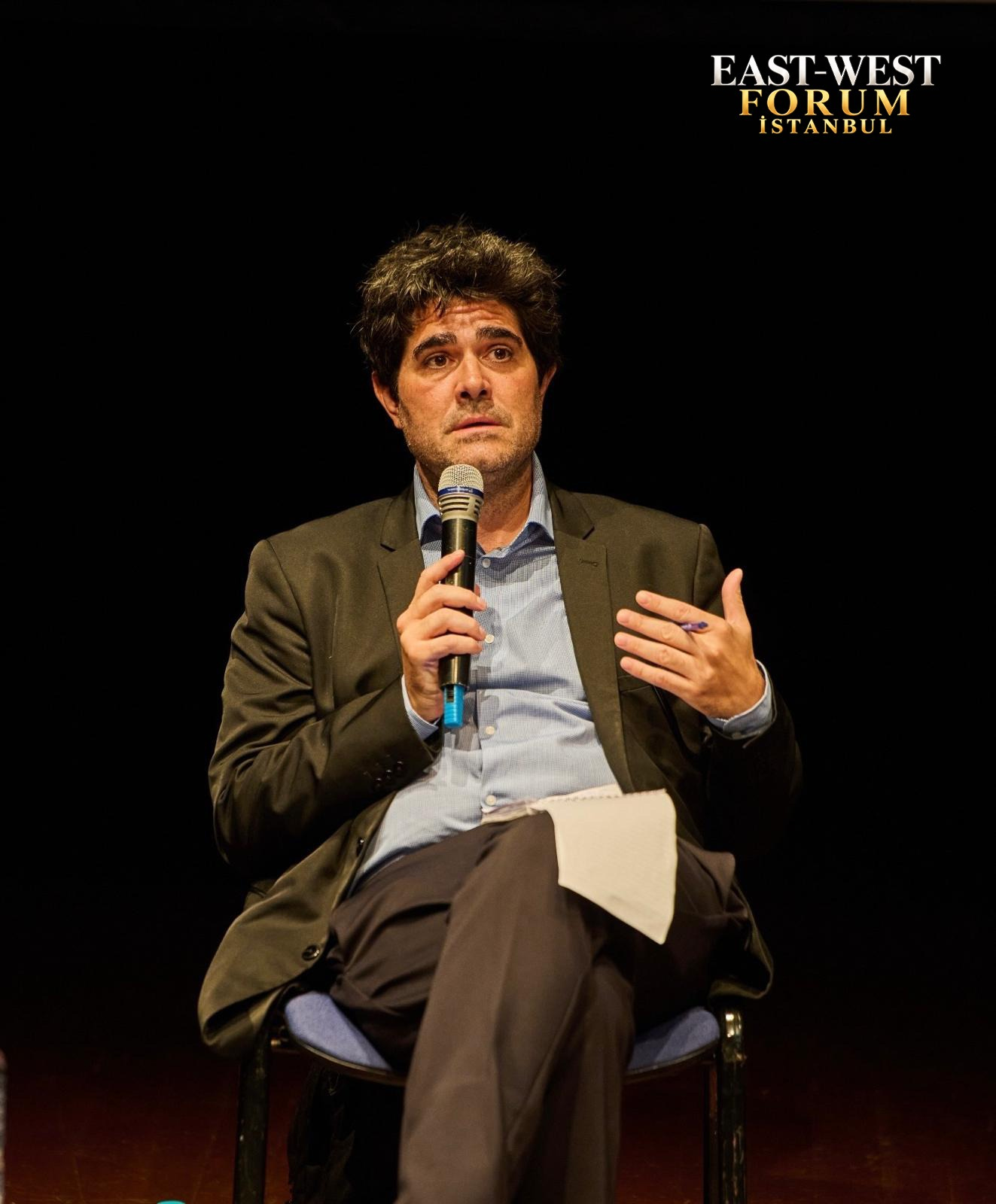
This is the transcript of the speech that I gave at the first edition of the East-West Forum in Istanbul on September 26, in which I argued that European countries have been blatantly undermining their fundamental economic and security interests, especially in the context of the Ukraine war, and that this can only be explained in the context of the continent’s vassalisation — i.e., its subordination to transatlantic interests as a result of a process that has been ongoing since the Second World War. I emphasised that NATO operates as an apparatus to control the continent rather than a defence organization, and also noted that the EU functions as the political wing of this imperialist order.
I should like to begin my remarks with a remark made by Professor Panda this morning when he spoke of the return of the national interest. This gave me quite a bit to think; because although it is valid for many countries in the world, I think there is a huge exception to this rule. That big exception is Europe.
If we look at the steps taken by European countries in recent years in economic policy, in the fields of security, in geopolitics and especially when it comes to the war in Ukraine, it is impossible to claim that these countries have been pursuing their national interests, no matter how much you stretch the concept. European countries have systematically undermined their core economic interests, security and geopolitical interests. The obvious question then is: why? In my opinion, there are two possible explanations for this.
One possible explanation is the following: European leaders have been misguided, they have acted imprudently; despite all the hard evidence to the contrary, they have pursued and are still pursuing what they believe to be the national interest of their country. Now, if it had impossible to predict the consequences of these policies, perhaps this possibility would be conceivable. However, this was not the case at all. For example, it was obvious that severing ties with cheap Russian gas would be disastrous for Europe.
Many of us, including me, wrote this as early as February or March 2022. We were able to predict this not because we are clairvoyants, but because it was evident. Just as it was evident that Ukraine had no chance of defeating Russia militarily, even with NATO support; therefore, it was just as obvious that pushing for a maximalist military-only solution to the conflict would spell disaster for Europe, not only economically but also in terms of security. This was even truer for Ukraine itself, of course.
Many of us have been saying this from day one. Therefore, unless we assume that European leaders were too dumb — and as dumb as some of them undoubtedly are — to see this reality that was obvious to many observers, that is, that this policy clearly ran counter to Europe’s interests, and then to see that doubling down on that policy would only make things worse, we have to consider the other alternative on the table: that European elites, for a long time, have not been pursuing the national interests of their respective countries, nor the collective interests of Europe as a whole.
In other words, the classical realist framework, which suggests that all states tend to defend and maximise their interests in economic, military and similar terms, doesn’t seem to apply to Europe. Because, when viewed from this theoretical perspective, the line followed by Europe remains completely irrational. We therefore need a different conceptual framework in order to make sense of European politics; and I believe that the most useful framework in this case is that of “vassalisation”. In the simplest terms, Europe — by which I mean virtually all EU countries and the entire Brussels establishment — has been hijacked by a transnationalised transatlantic elite that doesn’t care in the slightest about the concrete interests of their own countries and is in fact beholden to completely different interests: private interest, i.e., the interests of a narrow oligarchy — today, mainly the interests of transnational financial circles and military-industrial structures — and foreign interests, namely those of Washington’s imperial core (and, as a by-product, of Israel).
So how did we get to this point? Undoubtedly, this is the product of a very long process that emerged right after the end of the Second World War. The United States identified Europe as one of the key pillars of its global dominance strategy at the time. Projecting American power around the globe required keeping Europe under economic, military and also cultural control. Europe has effectively been under US military occupation since World War II. Even though eighty years have passed since the end of the war, there are still nearly 100,000 American soldiers stationed on the continent. Some 30 strategic American bases throughout Europe remain in existence. According to official discourse, they are here to protect us. Protect against whom? Against Russia, which poses no real threat to Europe?
In fact, I would argue that Russia didn’t pose a real threat even during the Cold War years. This threat was, in fact, largely manufactured and inflated by NATO itself. Naturally, NATO never aimed to defend Europe. Its main aim was to always keep Europe under control, to ensure that the continent was subordinated to American strategic interests, and to project American power throughout the world. This was true yesterday and it is even truer today. NATO today not only ensures that Europe remains aligned with US interests — and the Russia-Ukraine war is the most obvious example of this — but also serves to project American power around the globe. Just the other day, NATO Secretary General Mark Rutte, known for saying the quiet part out loud, stated that 5,000 sorties were made from American bases in Europe in support of the US-Israeli aggression against Iran.
Europe is therefore fully complicit in this attack on Iran, despite messages of condemnation from some leaders. In reality, Europe forms an essential part of the logistical infrastructure of American military power, allowing it to project eastward, towards Russia, as well as southward, towards the Middle East. All the NATO 3.0 chatter or narratives about the so-called rupture between Europe and the US are therefore just a huge theatre. On the contrary, NATO 3.0 will further reinforce Europe’s subordination to the “alliance”.
NATO was, of course, only one of the instruments. America’s national security apparatus also established extremely close links with the security apparatuses of European countries. And, of course, the US has long exercised tremendous economic, technological and financial control over the continent. It has also established massive cultural and ideological domination on the continent — not just through popular culture, but also through the English-language media, transatlantic think tanks and faux “non-governmental organisations”. Then there is one final tool, which is often overlooked but which, in my opinion, is crucial: the European Union itself.
The European Union has long been presented as a potential counterweight to American power, but it has never functioned as such. In fact, it has always been a critical lever that has chained Europe to the US-led transatlantic NATO system; it has effectively functioned as NATO’s political arm. This situation is particularly evident today under Ursula von der Leyen, who has made extraordinary efforts to align European countries with US interests, even against the will of individual European governments.
Today we are at an extremely dangerous threshold. Because, through the EU, which is a structurally undemocratic institution, the transatlantic NATO establishment has established full economic and political dominance over European countries. These are not sovereign countries by any definition; and therefore, they are not democratic, to the extent that sovereignty is the precondition for popular self-rule. This situation makes the possibility of achieving a systemic transformation through the ballot box even more difficult.
To sum up, I can easily say that Europe is an occupied continent in many respects. Thus, how the peoples of Europe can break away from the transatlantic system and achieve decolonisation is perhaps the most vital question facing the continent today.
Of course, Europe’s predicaments predate before America’s emergence on the scene as a global empire. The essence of the problem lies in the deep-rooted hostility that European economic and political elites have felt towards democracy and the working classes for centuries. When using the concept of “liberal democracy” today, we assume that democracy emerged spontaneously from liberalism. This is a complete lie. All of the great liberal thinkers of the past were opposed to democracy, that is, mass democracy, intended as a political order in which everyone has equal voting rights.
The democracy they imagined was a democracy of the propertied classes, of the capital-owning classes. Indeed, mass democracy was achieved in large part thanks to the often bloody struggles of the working classes and the socialist movement. Therein lies the main issue. The peoples of Europe have had to wage a fierce struggle against their own elites from time immemorial.
We have some of the worst elites in the world. Not only do they not care about the well-being of the people of the Global South; they do not care one bit about the well-being of their own people, the people of Europe. This is why Europe has been mired in violence, political conflicts and class struggles from the past to present. Even in the “golden age” of Western capitalism, after the Second World War, mass democracy was highly conflictual. I am Italian: my country was the scene of massive waves of political violence in the Seventies and Eighties. Similar dynamics occurred in Germany, France and all the major European countries. And this is considered the heyday of mass democracy; and in many respects it was — it was precisely in these decades that the greatest social and economic gains for the broad masses of people in Europe were achieved — but these gains were not only the result of elections, but also of mass mobilisation and high-intensity, and often violent, political conflicts. In my opinion, this picture reveals a much deeper knot. The rights obtained in the post-war period were not granted to the people; it was the consequence of the fact that, for a brief historical period, the organised power of the working classes, the broad masses, were able to wrestle some power away from the organised power of capital — though these were always relative gains.
The problem is that the basis — the concrete material conditions — that made mass democracy possible have disappeared in many respects today. Mass production sites and large factories where workers came together and organised no longer exist. Therefore, the structural and material conditions that created mass democracy have largely disappeared. Beyond the question of freeing ourselves from US imperial tutelage, which also means dismantling the EU, the other crucial question then is: how can we restore democracy and once again wrestle some power and control away from the political and economic elites when the material basis on which we achieved these gains in the past no longer exists? Our elites are acting in a completely unbridled manner today precisely because there is no real counterweight left to stand against them. Herein lies the crux of the matter.
Thanks for reading. Putting out high-quality journalism requires constant research, most of which goes unpaid, so if you appreciate my writing please consider upgrading to a paid subscription if you haven’t already. Aside from a fuzzy feeling inside of you, you’ll get access to exclusive articles and commentary. Alternatively, you could buy me a coffee!
Thomas Fazi
Website: thomasfazi.net
Twitter: @battleforeurope
Latest book: The Brussels Empire: The EU’s Silent Coup Against Democracy (German version only for now: Die Brüsseler Tyrannei: oder Der diskrete Staatsstreich)
>>The rights obtained in the post-war period were not granted to the people; it was the consequence of the fact that, for a brief historical period, the organised power of the working classes, the broad masses, were able to wrestle some power away from the organised power of capital — though these were always relative gains.<<
We are not voting out this demon in the next election cycle. 'Democracy' is their favourite tool for keeping plebs docile.
We must talk very soon!! The ruse of democracy has people flatfooted and illequipped to fight back