

Putting out high-quality journalism requires constant research, most of which goes unpaid, so if you appreciate my writing please consider upgrading to a paid subscription if you haven’t already. Aside from a fuzzy feeling inside of you, you’ll get access to exclusive articles and commentary. Alternatively, you could buy me a coffee!
This is an edited transcript of my recent interview Roger Köppel, editor-in-chief and publisher of the Swiss weekly Die Weltwoche, which was published today. The full video interview (in English) can be found here.
Thomas Fazi comes from the left and still describes himself as a socialist — a rarity among critics of the EU, whose opposition today mostly comes from the right. Since his first book on the euro crisis in 2014, he has viewed European integration as a process that was elitist and hostile to democracy from the very beginning. In his new book, Die Brüsseler Tyrannei oder Der diskrete Staatsstreich (Westend Verlag), he takes this thesis to its furthest conclusion.
Weltwoche: Mr Fazi, please introduce yourself briefly. Who are you, and what is your greatest concern?
Fazi: I’m an author and journalist, and I’ve been writing for a long time about economic issues, but above all about European integration. My first book, a critique of the EU’s response to the euro crisis, came out in 2014. I’m something of an anomaly in that I come from the socialist left, and indeed I still consider myself a socialist, whereas scepticism towards the EU today comes almost exclusively from the right. Yet it used to be the left that stood in the front line of the struggle for sovereignty and against the EU. My position has remained the same: European integration is one of the main causes of the erosion of democracy in Europe.
Weltwoche: You say the EU didn’t simply lose its way, but was an anti-democratic project from the outset.
Fazi: Exactly. In my book I argue that this is not an original benign project that has gone astray. It was an elitist, oligarchic project from the start — it’s just that this is now becoming impossible to ignore. The countries that use the euro, above all, no longer have any sovereignty; the key economic decisions are taken in Brussels and Frankfurt. And for me, sovereignty is the precondition for democracy. We already saw during the euro crisis how these institutions imposed Brussels’s neoliberal agenda on states — often against the will of citizens, of voters, even of governments.
Weltwoche: And today?
Fazi: Today it has turned into something even more frightening: a virtually historically unprecedented continental empire that rules over the lives of 450 million people without being open to democratic challenge. It runs vast propaganda operations, channels money to NGOs, the media and universities, censors through instruments such as the Digital Services Act (DSA) and now intervenes directly in national elections. In Romania, an entire election was annulled in 2024. And to crown it all, the EU is leading an insane drive towards war with Russia. Far from being a peace project, it has turned out to be a war project. The EU has become an existential threat to Europe.
Weltwoche: Let’s talk about the unrest we’re currently seeing in many European cities — in France, Germany, Portugal. What does that have to do with your subject?
Fazi: Everything. People focus on the violence, but it arose in the context of mostly peaceful mass demonstrations, driven by tens of thousands of students — not only in France, but also in Italy, Spain, Portugal, Belgium, Greece and Germany. It’s a kind of generational revolt. These young people are demonstrating against a system that has failed them. Their parents’ social contract — work hard and you’ll secure a job, a home, a family — has collapsed. They have borne the brunt of the neoliberal policies that were, to a large extent, imposed by Brussels.
Weltwoche: In what way?
Fazi: The cheap-money policies of the central banks, including the ECB, drove up asset and property prices and locked the young out of home ownership. Work was made more flexible and, at the same time, more precarious. Austerity hollowed out schools, universities and the health service. And now they’re being told: there’s going to be even less money for education and hospitals, because we have to pay for weapons. There is never any money for what people actually need, but always money for war. You don’t need a master’s degree in economics to realise you’re being taken for a ride.
Weltwoche: At the same time there is the violence in the suburbs, which in France also involves second-generation children of immigrants.
Fazi: That’s a fact, and there’s no point in denying it. You can acknowledge both things at once: that mass immigration has created ghettoised parallel societies — a social time bomb — and that the young people demonstrating have legitimate grievances. But the notion that these people, second- and even third-generation and born here, can simply be removed through remigration is a fantasy. And even if it were possible, it wouldn’t solve the structural problems facing young Europeans.
Weltwoche: But the same young generation is also rebelling from the right — at the ballot box, for parties such as the AfD or the Rassemblement National. Are we witnessing a kind of French Revolution?
Fazi: There’s something in that. An equally large part of this generation is challenging the establishment from an entirely different political direction, by voting for the AfD or Le Pen. The interesting thing is that these two camps, which regard each other as mortal enemies, are in many cases directing their anger at the same establishment, at the same policies. The big point of disagreement is immigration. Interestingly, the more conservative young people are often more aware of the reality of the EU; the left long ago internalised the pro-European gospel.
Weltwoche: After the AfD’s success in Saxony-Anhalt, Friedrich Merz said he was “shocked”.
Fazi: The historical parallels almost write themselves. When NATO was recently awarded the Peace of Westphalia Prize, Merz and NATO Secretary General Mark Rutte stood on the balcony smiling, while down below people were demonstrating and booing them both. Awarding a peace prize to the most aggressive war organisation in the world — there’s something deeply Orwellian about that, where words mean the opposite of what they say. The whole scene was reminiscent of Ceaușescu’s final days.
Weltwoche: So you see the EU as being in crisis.
Fazi: In a deep crisis. It can no longer deliver the material security with which it kept people content in the Nineties. And its ideological hegemony is crumbling. Not for want of trying — the uniformity of the mainstream media is unprecedented. But propaganda only works as long as it is subtle; once it becomes too obvious, it stops working. That is why the regime is now resorting to ever more repressive means: it annuls entire elections, Le Pen is effectively having to run her election campaign under house arrest, and in Germany there is open talk of banning the AfD. But any regime that drops its democratic mask and shows its authoritarian face is already losing — because that only accelerates its delegitimisation.
Weltwoche: How threatening is this Brussels tyranny? Is it a tyranny of weakness and incompetence or is there a real danger that the war will be used as a means of seizing power?
Fazi: It wouldn’t be the first time that European elites have waged war in order to avoid confronting social and economic tensions at home. War channels society’s energies outwards, against an external enemy. What’s astonishing about this generation of leaders is how openly they say so. Russia is the pretext. The threat is largely manufactured: there is no evidence and no reason to believe that Russia wants to attack Europe — even NATO officials now admit as much. Russia is the last grand narrative they have left to justify all these authoritarian measures. That’s why they are in an outright panic at the thought that the war might end.
Weltwoche: Isn’t there a danger that this narrative will become reality? That the bear will be poked until it strikes back?
Fazi: That is the real danger. Even if their calculation is merely that Russia can be provoked endlessly without things escalating, that is extremely dangerous. NATO is systematically enabling serious attacks deep inside Russian territory, on Russian infrastructure. We are the ones currently waging war on Russia. So far Russia has refrained from paying us back in kind, but on what assumption rests the certainty that it never will? And one can imagine an even more disturbing scenario: that European elites are actually working towards open war, out of a kind of collective death drive — better to destroy everything than to lose power.
Weltwoche: Ukrainian President Volodymyr Zelensky came to power promising to make peace with Russia. Do you fear a third world war in Europe in the next six to twelve months?
Fazi: One has to draw distinctions. Trump may be serious about wanting a peace deal. But there are powerful forces within the US security apparatus that still want the war — the Ukrainian attacks on Russian refineries are also made possible by US intelligence, satellites and the CIA. So there is a conflict within the American state itself, and the Europeans are likely coordinating with the transatlantic war establishment in the US. If it really came to an open NATO-Russia war, it wouldn’t be a war of attrition as in Ukraine, but hypersonic missiles striking European cities. The consequences would be unimaginable. If that’s their game, they’ve lost their minds.
Weltwoche: Let’s turn to Switzerland. We will soon be voting on the institutional agreements with the EU. What is your advice?
Fazi: For Switzerland, deepening integration with the EU at this moment would be sheer madness. It wouldn’t have made sense thirty or forty years ago either. But handing more power to the EU today, given its authoritarian, warmongering trajectory, would be a catastrophe. Switzerland is living proof against the lie that small countries can only thrive within the EU. Iceland proves the same thing, and countries such as Poland and Hungary, which were shrewd enough to join the EU but not the euro, have in many respects fared better than countries that joined the single currency, because they retained considerably more sovereignty.
Weltwoche: Can sovereignty, once surrendered, ever be recovered?
Fazi: That’s the crucial point. The EU’s founders understood this perfectly: you begin by cooperating on small, innocuous matters that alarm no one, but supranationalism then generates its own path dependency. In every crisis there is then a tendency to hand even more power to these institutions, because you no longer have the means to respond yourself. It’s a slippery slope: once you’ve taken the first step, you inevitably slide further. That door would keep opening wider and wider, and reversing the process is almost impossible.
Weltwoche: The right-wing parties have since toned down their calls to leave. Have they been corrupted by power?
Fazi: I wouldn’t speak of corruption; I’d think about it structurally. If you regard the EU as an empire and the member states as colonies, then it’s in the nature of a colonial system that it doesn’t allow its colonies to vote their way out of the empire democratically. The first wave of EU-critical parties was naïve. In 2018, when the Lega and the Five Star Movement took office, Italy buckled under pressure from Brussels. The next wave, people like Meloni, understand the colonial arrangement. They know that on the big questions of economic and foreign policy they have little choice but to submit to the diktats from Brussels.
Weltwoche: Then only the citizens are left. In Switzerland in 1992, almost all the parties were in favour of joining — and the people said no by a whisker.
Fazi: That is precisely the blessing of direct democracy: it is a prison for politicians. They have to justify themselves constantly; they can be called to heel. That is what’s missing in Europe. But if you want more direct democracy in other countries, you first have to get out of the EU, because direct democracy needs sovereignty in order to have any effect. You can let citizens vote on everything, but if the decisions end up being taken in Brussels anyway, it’s pointless. The Swiss model shows the way, especially in the internet age, when people could vote almost daily — and would mostly make wiser decisions than our corrupt elites.
Weltwoche: A highly topical example is Poland, where the pro-European government is moving against its own constitutional judges.
Fazi: No one is outraged about it, and yet this goes to the heart of the matter. They hate the fact that there are still constitutional judges in Poland who take their constitution seriously — judges who have ruled in the past that Polish law takes precedence over EU law. That is the ultimate heresy in the EU, because the entire architecture rests on the principle of the primacy of EU law: i.e., that ultimately the EU stands above national laws and constitutions. What is at stake in Poland is the elimination of the last bastions of resistance — all the way to the country’s complete absorption into the EU system, including giving up its own currency, which would be contrary to the Polish constitution. It is exactly your Swiss demand: “Swiss law instead of foreign judges”. Anyone who upholds national sovereignty and the rule of law is punished, because Brussels itself doesn’t have a rule of law with separation of powers.
Weltwoche: Finally: how do you convince the left that this supranational globalism contradicts its own ideals?
Fazi: The problem is that there is no real socialist left any more. What passes for the left today has almost nothing to do with the old labour movement; it’s a progressive-liberal mush that revolves around individual identity. The left once wanted to overcome differences and unite people on the basis of shared class interests. Liberal progressivism does the opposite: it finds all these ways of dividing workers, based on what pronouns you use, etc. Honestly, I’m less interested in convincing the left than in combining the best ideas of both traditions: the old left’s ideas of economic democracy and the cultural common sense of conservatives. The old Europe was half Christian, half socialist, united by the idea of the common good. Left and right today are above all tools used by the elites to divide people. We all need peace, development and economic sovereignty — and that is neither left nor right.
Thanks for reading. Putting out high-quality journalism requires constant research, most of which goes unpaid, so if you appreciate my writing please consider upgrading to a paid subscription if you haven’t already. Aside from a fuzzy feeling inside of you, you’ll get access to exclusive articles and commentary. Alternatively, you could buy me a coffee!
Thomas Fazi
Website: thomasfazi.net
Twitter: @battleforeurope
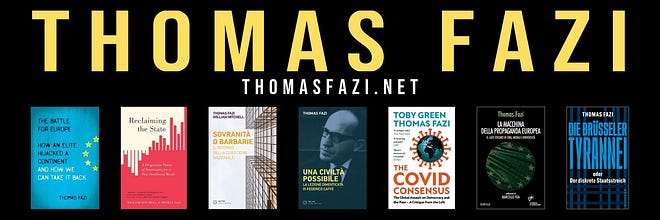
Latest book: The Brussels Empire: The EU’s Silent Coup Against Democracy (German version only for now: Die Brüsseler Tyrannei: oder Der diskrete Staatsstreich)
