

Putting out high-quality journalism requires constant research, most of which goes unpaid, so if you appreciate my writing please consider upgrading to a paid subscription if you haven’t already. Aside from a fuzzy feeling inside of you, you’ll get access to exclusive articles and commentary. Alternatively, you could buy me a coffee!
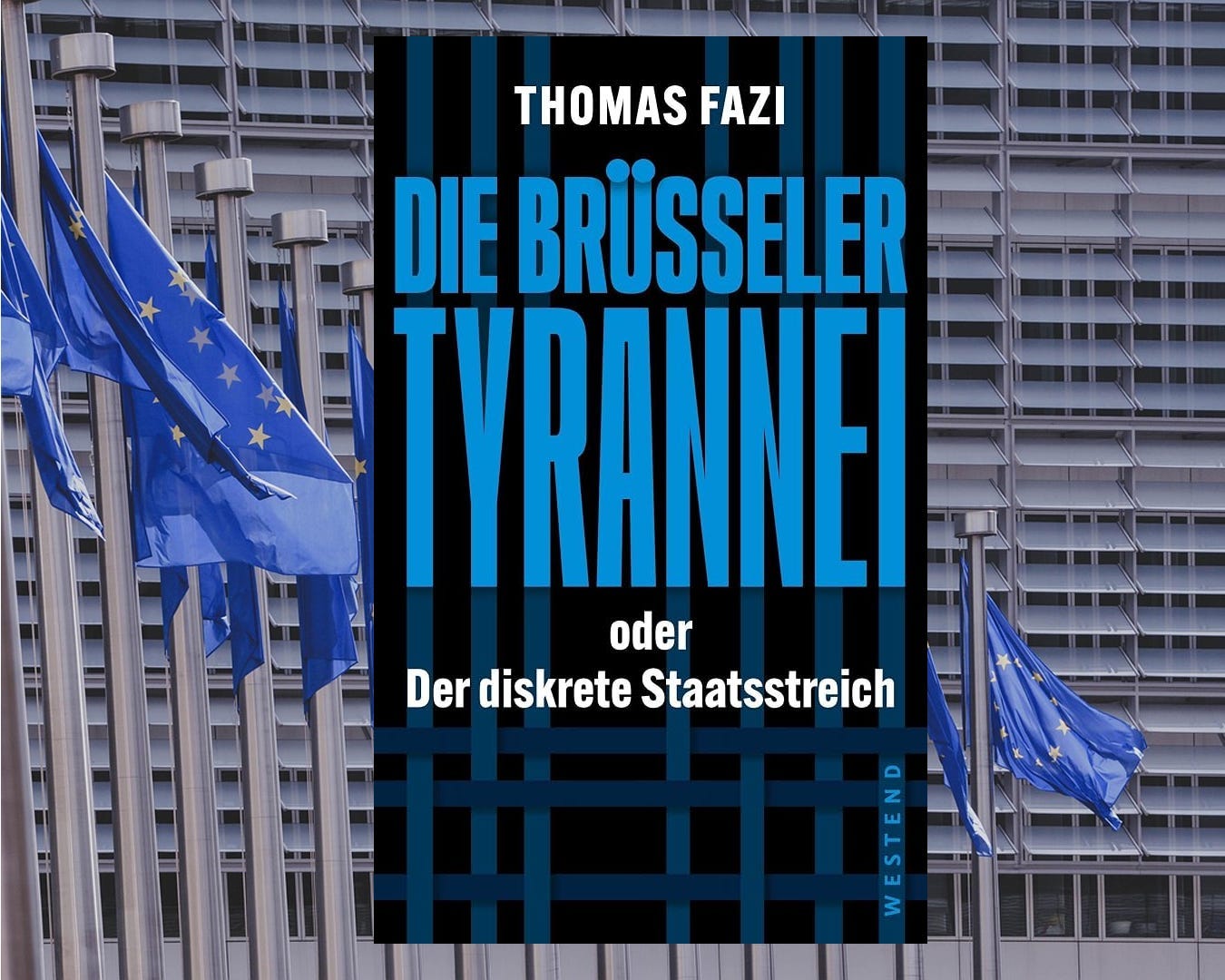
I’m delighted to republish a fantastic review by Thierry Simonelli, psychoanalyst, researcher and author, of my latest book published last month in German, Die Brüsseler Tyrannei (Westend). The article also offers a very thorough overview of how my thinking about the EU has evolved over the past decade. It was originally published on Simonelli’s Substack, which I strongly recommend you follow.
In The Battle for Europe, published in 2014, Thomas Fazi examined how Europe’s financial crisis became the occasion for rescuing the banks at public expense. Institutions whose recklessness had helped precipitate the crash saw their losses transferred to the public. To keep payments and credit flowing, governments injected public money into failing banks and guaranteed their liabilities. The rescue also shielded creditors from losses they would otherwise have faced: preserving an essential social function justified public protection for private financial claims (Fazi, 2014).
However, this bailout was not simply the emergency rescue of banks still directing most of their credit to productive businesses. The United Kingdom, Europe’s largest financial centre, offers a particularly well-documented case. Bank of England data show that lending by UK-resident banks to non-financial, non-real-estate businesses fell from about a third of total lending in 1986 to less than 10% by 2014 (Mazzucato and Macfarlane, 2017). Public guarantees thus sustained banking systems in which most lending went to households, commercial property and the financial sector itself.
The familiar formula was that the privatization of profits was underwritten by the socialization of losses. The European Union had apparently found a form of socialism it could embrace, provided the beneficiaries were bankers.
Austerity carried this transfer into a second stage. To obtain bailout loans, governments accepted conditions that reached deep into employment relations. Alongside cuts to public services and public employment came pressure to reduce wages and weaken collective bargaining. Portugal shows what this meant for workers. As the government restricted the extension of sectoral agreements, the number of workers covered by sectoral agreements newly concluded or revised during the year fell from approximately 1,309,300 in 2010 to 291,100 in 2012 (OECD, 2017). Existing agreements often remained legally valid, but the collapse in their renewal increasingly left workers dependent on terms negotiated years earlier. Workers were thus required to accept lower earnings and greater insecurity as part of a rescue designed to safeguard creditors (Bieler & Jordan, 2015; Deakin & Koukiadaki, 2013, pp. 178–181).
The political justification required a corresponding reversal of responsibility. Having intervened to rescue financial institutions, European authorities demanded sacrifices from populations now accused of living beyond their means. In the end, those bearing the costs of the crisis were recast as its authors (Fazi, 2014, Preface).
This might have looked like a crisis mismanaged. For Fazi, it was rather a means of reorganizing class relations on a large scale. State intervention protected financial wealth, while austerity shifted the adjustment onto workers and users of public services, weakened labour’s bargaining power, and narrowed the provision on which households depend.
Fazi’s response in 2014 began with the imbalance that European integration had created. Capital could move across borders, while taxation and social protection remained largely national. Consequently, governments faced pressure to attract investment by reducing the taxes and labour costs borne by businesses. And under these conditions, defending social provision within each country became increasingly difficult. The idea then was that a European welfare state would bring redistribution to the scale at which markets already operated. A progressive tax on capital and wealth, backed by shared borrowing, should pay for social guarantees across the Union. This would make it less necessary for member states to compete at the expense of workers.
Such a programme obviously would have required European authorities endowed with substantial powers over economic policy. Giving those powers to institutions already enforcing austerity, however, raised the question of who would determine their use. Because an empowered European Parliament and an elected European executive would have to make the direction of policy subject to electoral choice, democratization formed a necessary condition of Fazi’s economic proposals. Within this framework, Fazi’s Green New Deal and European social compact should give citizens the means to influence investment and redistribution. The sequence of this procedure was decisive: democratic reform should first make common economic powers accountable, and then allow Europeans to use integration to reverse the social consequences of the crisis (Fazi, 2014, Chapter 6).
Twelve years later, Fazi has abandoned that hope. In Die Brüsseler Tyrannei, it is the Union’s institutional architecture itself that has come to obstruct democratic self-government. The earlier criticism of the technocratic and neoliberal character of the Union had left open the possibility of a transformation from within. Fazi now argues that European integration was designed from the outset to limit what electoral majorities could change in economic policy. The institutions he once hoped to democratize had been built to restrict the very power he wanted citizens to exercise.
This revised diagnosis calls for a radical change in the possible political solution because democratization requires a break with the institutions Fazi once hoped to reform. He nevertheless insists that recovering national sovereignty would supply only the institutional conditions for democracy. The popular influence achieved during the postwar decades depended on organized movements capable of forcing concessions from those who held power. With their present weakening, elected governments have become increasingly detached from the citizens they formally represent. Withdrawal would leave that domestic balance of power to be confronted. His conclusion therefore demands something considerably more difficult than recovering national policy instruments. It would necessitate a rebuilding of the collective capacity to determine their use. How such power could emerge under present conditions remains an open question in his account (Fazi, 2026, Chapter 14).
Fazi’s abandonment of reformism brings us back to the origins of European integration. How did democratic governments build an order that progressively restricted their citizens’ power over economic policy?
The first part of the book traces the role national elites played in constructing supranational constraints they could subsequently invoke against demands for political change. Understanding how those limits were established helps explain why he now considers a democratic transformation of the Union impossible.
Die Brussels Tyranny begins with the conflict concealed within the familiar expression “liberal democracy”. Democracy gives citizens equal political standing and the authority to determine their common affairs. Within the liberal tradition, however, private property enjoys extensive protection against collective intervention. In consequence, extending voting rights to workers raised a difficulty for the propertied classes. What, after all, would prevent an electoral majority from challenging the economic power of its employers?
Earlier historical arguments for restricting political participation reveal this concern. During the French Revolution, Sieyès distinguished between active citizens entitled to participate in government and passive citizens entitled to legal protection. In the following century, John Stuart Mill proposed giving additional votes to the more educated. The prospect of political equality threatened a distribution of power that these restrictions helped preserve (Fazi, 2026, Chapter 1).
Universal suffrage made this conflict between democracy and liberalism harder to contain through restrictions on voting alone. Protecting property, Fazi argues, increasingly depended on limiting what elected governments could change. The solution that proved most durable was the separation of political authority from economic power. The only practical and durable solution for this problem was the separation of political authority from economic power. Citizens could choose their governments while owners retained authority over production and employment.
Fazi finds the logic of this arrangement anticipated in Hayek’s 1939 essay “The Economic Conditions of Interstate Federalism”, which, in Streeck’s phrase, reads like a blueprint for today’s European Union. By joining a federation, states would surrender instruments of economic intervention. At the same time, the differences among their populations would obstruct agreement on redistribution at the federal level, so that economic powers removed from national control would remain unavailable to democratic majorities at either level. In this logic, elections would continue, preserving the appearance of democratic choice, though their winners would lack essential means of implementing alternative policies. For Fazi, the neutralization of democracy was not a design flaw of interstate federalism but its very purpose (Fazi, 2026, Chapter 1).
Two rulings by the European Court of Justice changed the authority of European law within the member states in this sense. In Van Gend en Loos in 1963, the Court established that individuals and companies could invoke certain provisions of Community law before their own national courts. European treaties thereby became a source of enforceable rights within each country. And one year later, Costa v. ENEL determined that Community law took precedence when national legislation conflicted with it. A parliamentary majority could therefore pass a law that its own courts would have to set aside because it contradicted European obligations. Together, these judgments gave the treaties a constitutional authority that national elections could no longer overturn (Fazi, 2026, Chapter 2).
Alongside these legal limits, monetary integration increasingly constrained the economic choices available to elected governments. France supplies a revealing example of this mechanism. Elected in 1981 with a programme of nationalization and redistribution, Mitterrand faced capital flight and pressure on the franc. He had to face the fact that maintaining France’s position within the European Monetary System conflicted with continuing his expansionary programme. Eventually, in March 1983, he chose to preserve that monetary commitment and turned towards austerity (Fazi, 2026, Chapter 3).
With Maastricht, this choice finally became embedded in the design of monetary union. Joining the euro meant relinquishing national control over currency and accepting common fiscal rules. Also, monetary policy would now rest with the European Central Bank, independent of government instructions. Under these circumstances, what could voters then accomplish by electing a government committed to a different economic programme? That government’s mandate would confer no authority over the central bank, while changing the fiscal framework would require agreement beyond the electorate. As a result, the means of delivering political change had become increasingly remote from those entitled to demand it (Fazi, 2026, Chapters 3 and 4).
Greece exposed the consequences of this change in 2015. Elected to challenge austerity, its government depended on a banking system whose access to emergency liquidity remained subject to the ECB. When the Bank maintained its liquidity ceiling before the referendum, Greek banks closed and daily cash withdrawals were limited to €60. Rejecting the creditors’ proposals at the ballot box could neither reopen the banks nor secure additional liquidity. Despite that rejection, the government was subsequently forced to accept another austerity agreement. For Fazi, this episode reveals what the loss of monetary sovereignty entails. Citizens could refuse the creditors’ terms, but they had no corresponding power over the institutions controlling the financial conditions under which their refusal could be sustained (Fazi, 2026, Chapter 5). An example of liberal democracy at work.
Successive emergencies extended this method into new fields. During the pandemic, NextGenerationEU (the EU’s recovery programme, financed through common borrowing) gave the Commission additional influence over national reforms and investment. Under its main funding instrument, governments received payments as they met agreed milestones in recovery plans assessed by the Commission and approved by the Council. By assessing whether those commitments had been fulfilled, the Commission could authorise payments or suspend part of the funding. Access to recovery money thus gave it an additional means of influencing domestic policy. The response to the war in Ukraine extended this centralization into defence financing. Fazi’s telling example is Security Action for Europe (SAFE), a programme offering member states up to €150 billion in loans, principally for joint purchases of military equipment. To establish it, the Council used Article 122, a treaty provision for exceptional economic circumstances that allowed it to act without requiring the European Parliament’s approval.
Across these episodes, political leaders invoke emergencies to justify expanding executive power. Once the immediate crisis has passed, the arrangements established to manage it can outlast the circumstances that justified them. They also provide a precedent: when another crisis arrives, governments can draw on earlier emergency responses to justify further extensions of their authority. From crisis to crisis, exceptional procedures thus become familiar instruments of government, weakening parliamentary scrutiny and citizens’ ability to change the direction of policy (Fazi, 2026, Chapters 6 and 7).
The second part of the book then examines how this accumulated power operates. Fazi’s argumentative strength lies in connecting institutions usually discussed separately.
Who can voters hold responsible for a policy they want changed? National ministers like to point to European obligations, although their governments helped establish them. Following responsibility to Brussels brings citizens before the Commission that controls legislative initiative and a Council whose negotiations largely escape public scrutiny. And although the European Parliament can amend or reject proposals, the economic commitments embedded in European law remain beyond the reach of an ordinary electoral majority. Through this arrangement, governments acquire room to act together while making it harder for their own citizens to call them to account (Fazi, 2026, Chapter 8).
This distance from public scrutiny also determines who can exercise influence. Permanent officials and organized business interests possess the continuity and resources needed to intervene while proposals are being formulated. By the time legislation reaches public debate, much of the work of defining the problem and selecting acceptable solutions has already been done. Here, Fazi’s account gives the democratic deficit of the EU a very concrete social content. Moving decisions away from national electorates brings them closer to actors who can maintain a permanent presence in Brussels. The resulting imbalance then explains why market freedoms enjoy binding legal protection while demands for social change encounter institutional obstacles at every stage (Fazi, 2026, Chapter 8).
Technocratic government asks citizens to accept less control over economic policy in return for better results. Fazi takes that promise seriously and asks whether it has been fulfilled. His economic critique relies on the connection he draws between Europe’s disappointing performance and the rules defended as guarantees of competent government. Fiscal restrictions limit public investment, while competition rules constrain industrial strategy. Having surrendered important policy instruments, national governments struggle to address weak investment and widening economic disparities within a framework that helps perpetuate them (Fazi, 2026, Chapter 9).
This institutional design makes its own failures exceptionally difficult to correct. And paradoxically, poor results justify transferring further powers to the very institutions responsible for them. Ultimately electoral dissatisfaction leaves the direction of policy unchanged: voters can reject the results while the authorities responsible gain greater control over the response (Fazi, 2026, Chapter 9).
Under these conditions, influence over public debate acquires particular importance. If poor results are to justify further transfers of power, citizens must be persuaded that failure stems from insufficient integration. The institutions’ ability to shape how those failures are explained therefore helps protect their authority against challenges to the framework itself.
In this context, Fazi shows how European funding connects civil society organizations, journalism and academic programmes to the institutions they might otherwise scrutinize. In turn, the pressure on digital platforms extends this influence into the circulation of information itself. What happens to those who challenge official accounts becomes painfully tangible in his chapter on individual sanctions. For the journalist Hüseyin Doğru and the author and former intelligence analyst Jacques Baud, asset freezes and restrictions on receiving payments threaten the means of earning a living, without a criminal conviction. Their cases expose how readily institutions invoking European values can deprive individuals of basic protections against the arbitrary exercise of power (Fazi, 2026, Chapters 10 and 11).
Fazi’s argument reaches its most consequential point in the discussion of elections. Economic constraints had already restricted what successful candidates could do, but intervention in campaign conditions and candidate eligibility reaches even further into the process through which governments are chosen.
In Romania, the 2024 presidential election brought an unexpected challenge to the country’s established political direction. Călin Georgescu, an independent candidate from the nationalist far right, came first in the November vote. On 6 December, before the run-off could take place, the Constitutional Court annulled the election, citing campaign irregularities amid allegations of Russian interference. Georgescu was subsequently barred from standing in the rerun. Fazi questions the evidence supporting these decisions and examines how European oversight of digital platforms, security allegations and interventions by domestic authorities converged to exclude a candidate opposed to the prevailing European and NATO consensus. He does acknowledge that coordination at the highest level between Brussels and Bucharest has not been conclusively established. His argument nevertheless raises a broader difficulty. Several institutions, each exercising its own powers, can narrow electoral choice while leaving responsibility for the outcome dispersed among them (Fazi, 2026, Chapter 12).
Europe’s growing dependence on the United States further restricts what its citizens can change through elections since military structures, energy dependence and transatlantic networks bind European policy to American priorities. The book’s strongest insight concerns the relationship between this external dependence and the restriction of democratic choice at home. Commitments made beyond the electorate’s reach return as obligations that domestic opposition is expected to respect. Here again, governments help establish constraints beyond their citizens’ reach, then invoke those constraints against demands for change at home (Fazi, 2026, Chapter 13).
The final chapter of Die Brüsseler Tyrannei brings Fazi back to a question his first book on the European Union had answered differently: where can democratic power over economic life be rebuilt?
In 2014, his opposition to austerity led him to advocate a radical transformation of the Union. If markets operated across borders, democratic power needed the means to act at the same scale. A European welfare state, financed through progressive taxation and common borrowing, gave that hope a political programme. Twelve years later, however, Fazi considers the Union’s institutional structure the central obstacle to carrying it through. In the intervening years, each crisis has strengthened authorities whose power rests on keeping economic policy beyond effective electoral control (Fazi, 2014, Chapter 6; Fazi, 2026, Chapter 14).
Could a sufficiently powerful electoral movement nevertheless still force reform under these conditions? Today, Fazi considers this route effectively closed. Treaty revision requires agreement across all member states, making change dependent on a convergence of governments that the existing order itself works to prevent. And even such an unlikely victory would leave a deeper difficulty unresolved. A European Parliament and executive would need a political community willing to accept common decisions and sustain redistribution across national boundaries. Such a community, Fazi now argues, does not exist. The solidarity on which welfare states rest remains anchored in national identities, consolidated over a long history and not easily transferred to a larger, thinner framework (Fazi, 2026, Chapter 14).
This brings us back to the conclusion outlined at the beginning. For Fazi, withdrawal from the EU, and above all from the euro, is now the only viable route to recovering democratic control over economic policy. Yet he presents it as no more than a minimal institutional framework, one that would not by itself restore democracy. The Union, he argues, is as much a symptom as a cause of a crisis affecting democracy throughout the West. Drawing on Miliband, he locates the deeper problem in a permanent state apparatus that remains largely autonomous from elected governments. The post-war concessions had been wrested from it by organized movements, full-employment and mass parties, conditions that have since largely disappeared. The task, then, is not to restore a lost golden age but to reinvent popular self-government within sovereign political communities. And Fazi finds grounds for hope above all in the erosion of the American-led order on which the Union has depended (Fazi, 2026, Chapter 14).
This diagnosis is lucid, but it leaves its own central question unanswered. Fazi recognizes that power is concentrated within national states as well as above them. Yet he says little about how those with the least influence could overcome that concentration once sovereignty is recovered, and the sources of hope he identifies are geopolitical rather than social. Empirical research on political responsiveness suggests how demanding this task would be.
The conclusion is theoretically compelling. With democratic control restored, citizens could challenge economic arrangements previously placed beyond their reach. Yet the national institutions through which they would exercise that control already exhibit the problem Fazi identifies in the Union. Within member states, equal voting rights coexist with profound inequalities in political influence. Returning authority to those states would therefore bring economic decisions back into a political arena where ordinary citizens already struggle to make their preferences count. How would recovering national sovereignty enable them to overcome the same concentration of power they confront at European level?
In the Netherlands, Schakel (2021) examined 291 proposed policy changes between 1979 and 2012. When income groups disagreed, the preferences of citizens with low or median incomes had no statistically discernible independent effect on policy outcomes, while those of affluent citizens remained influential. Equal voting rights, in other words, can coexist comfortably with pronounced inequality in whose preferences governments translate into decisions.
Germany provides a second example. Across 746 survey questions concerning proposed reforms between 1980 and 2013, Elsässer et al. (2021) found that policy decisions favoured higher occupational and educational groups, irrespective of policy type and of the parties in government.
One might object that these findings reflect the very constraints Fazi denounces: Dutch and German governments were, after all, already bound by European rules throughout the periods studied. Yet, the same pattern appears where no such constraints apply. In the United States, Gilens (2012) found that when the preferences of affluent citizens diverged from those of the middle class or the poor, policy outcomes bore virtually no relation to the wishes of the less advantaged. In Germany, moreover, the bias held irrespective of policy type, in economic and cultural questions alike, many of which, such as pensions, welfare or labour market reform, remain largely under national control. Unequal responsiveness, in other words, does not need Brussels to exist.
These findings give empirical precision to what Fazi diagnoses in general terms, and they show how demanding the task he leaves open would be. Unless the domestic distribution of political power changes, governments released from European constraints would remain disproportionately responsive to their most privileged citizens. Sovereignty would return the struggle to the national level; it would not decide its outcome.
The difficulty is that those with the greatest interest in changing this distribution are precisely those whose preferences carry the least weight. Expecting their demands to prevail through the existing institutions assumes that they already possess the influence they are seeking to acquire, while those who benefit from the present arrangement have little reason to surrender it. Fazi rightly insists that democracy cannot be decreed from above. But neither can it be expected to emerge from institutions that have long ceased to answer to those below. Recovering sovereignty may be a necessary condition for democracy; the harder question, which the book leaves open, is who would have the power to make it one.
Fazi’s book leaves us with a question that is becoming increasingly difficult to avoid. What remains of democratic choice when the most consequential political decisions lie beyond the reach of voters? The expansion of executive power in times of emergency and war makes that question all the more pressing. So do attempts to control public debate and the use of political sanctions against journalists. Recovering the authority to make collective decisions remains a necessary task. Whether citizens can also acquire the power to shape those decisions is the struggle that lies ahead.
Die Brüsseler Tyrannei should be required reading for anyone concerned about the future of democracy in Europe. Fazi brings the institutions and decisions examined in this review into a sustained argument about the power citizens have lost and the conditions under which they might recover it. He shows how the European machine works and how it has progressively acquired its present shape. The history he retraces so convincingly also gives us reason to seriously worry about the Union’s future. The forces that produced the Union’s present institutions show no signs of weakening. Quite the contrary, they continue to shape its development, making the democratic deficit harder to overcome and raising the question whether it can be reversed at all.
Literature
Bieler, A., & Jordan, J. (2015). Focus: Austerity and Resistance — Labour in the Eurozone crisis. International Union Rights. https://doi.org/10.1353/iur.2015.a838486
Deakin, S., & Koukiadaki, A. (2013). The sovereign debt crisis and the evolution of labour law in Europe. In N. Countouris & M. Freedland (Eds.), Resocialising Europe in a time of crisis (pp. 163–188). Cambridge University Press. https://doi.org/10.1017/CBO9781107300736.011
Elsässer, L., Hense, S., & Schäfer, A. (2021). Not just money: Unequal responsiveness in egalitarian democracies. Journal of European Public Policy, 28(12), 1890–1908. https://doi.org/10.1080/13501763.2020.1801804
Fazi, T. (2014). The battle for Europe: How an elite hijacked a continent—and how we can take it back. Pluto Press. https://www.plutobooks.com/product/the-battle-for-europe/
Fazi, T. (2026). Die Brüsseler Tyrannei oder der diskrete Staatstreich (L. Krebbers, Trans.). Westend Verlag. https://westendverlag.de/Die-Bruesseler-Tyrannei/2495
Gilens, M. (2012). Affluence and influence: Economic inequality and political power in America. Princeton University Press; Russell Sage Foundation.
Mazzucato, M., & Macfarlane, L. (2017). Patient strategic finance: Opportunities for state investment banks in the UK (Working Paper No. IIPP WP 2017-05). UCL Institute for Innovation and Public Purpose. https://discovery.ucl.ac.uk/id/eprint/10195735/
OECD. (2017). Labour market reforms in Portugal 2011–15: A preliminary assessment. OECD Publishing. https://doi.org/10.1787/9789264269576-en
Schakel, W. (2021). Unequal policy responsiveness in the Netherlands. Socio-Economic Review, 19(1), 37–57. https://doi.org/10.1093/ser/mwz018
Thanks for reading. Putting out high-quality journalism requires constant research, most of which goes unpaid, so if you appreciate my writing please consider upgrading to a paid subscription if you haven’t already. Aside from a fuzzy feeling inside of you, you’ll get access to exclusive articles and commentary. Alternatively, you could buy me a coffee!
Thomas Fazi
Website: thomasfazi.net
Twitter: @battleforeurope
Latest book: The Brussels Empire: The EU’s Silent Coup Against Democracy (German version only for now: Die Brüsseler Tyrannei: oder Der diskrete Staatsstreich)

Nobody of influence and authority would tolerate democracy. When the voters agree with the elite consensus, then The Voice Of The People Has Spoken.
When the voters don't play along, we hear about how we have to make tough decisions. St..Winston Churchill is ritually invoked.
Good review.
“His conclusion therefore demands something considerably more difficult than recovering national policy instruments. It would necessitate a rebuilding of the collective capacity to determine their use. How such power could emerge under present conditions remains an open question in his account (Fazi, 2026, Chapter 14).”
At the outset of the 20th century there was a movement that was quite successful in restoring that “collective capacity”. So powerful, it even ended a world war. Time to study Marx and Lenin again. Time to rebuild a revolutionary party of the working class.