

In a few days the German edition (the only one so far) of my latest book, The Brussels Empire: The EU’s Secret Coup Against Democracy, will finally come out, with the title Die Brüsseler Tyrannei: oder Der diskrete Staatsstreich. You may order it here.
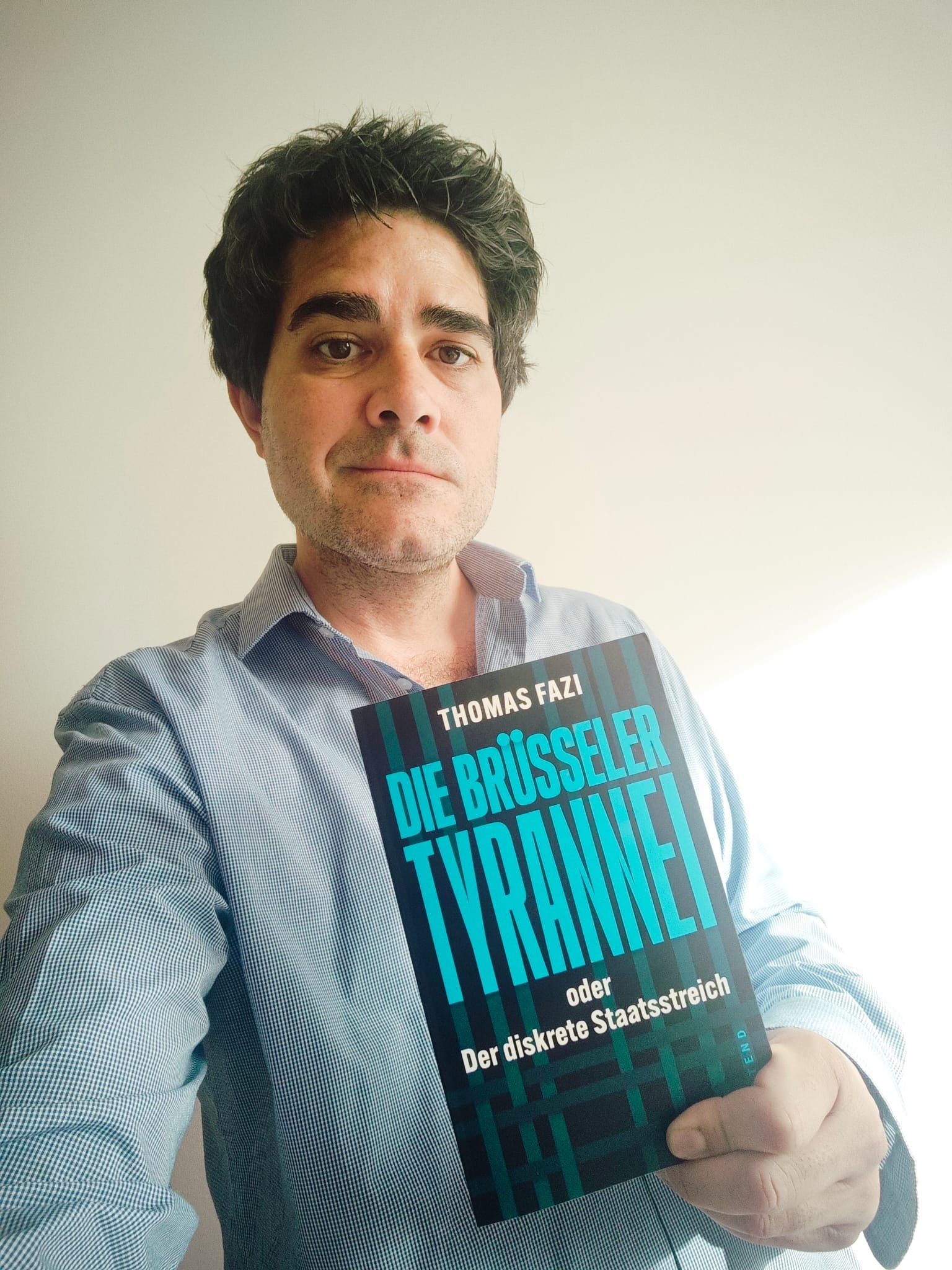
A few days ago I shared a detailed summary of the book. I’m now happy to share the book’s introduction, which was also published in German in the magazine NachDenkSeiten:
As someone whose political baptism of fire came in the anti-globalisation movement of the late 1990s and early 2000s, as a card-carrying member of the Italian radical left, I long held a neutral, even positive view of the European Union. Like most people in that milieu, I grew up believing that nation-states and national sovereignty were a reactionary, even fascist relic of the past — or at the very least that hyper-globalisation had rendered them obsolete — and that the EU was the answer: an attempt to make Europe stronger and more autonomous by getting countries to “pool” their sovereignty and thus better withstand the forces of the market, and, more broadly, to overcome the old national divisions and finally unite the peoples of Europe. That this was itself a variation on the globalist creed I claimed to oppose was lost on me at the time, as it was on almost everyone else in the movement. I had drunk the progressive-flavoured pro-European Kool-Aid.
I began seriously to question those views only after the 2008 global financial crisis, and above all during the so-called “European sovereign debt crisis” that followed. As I picked apart the official narrative about the political-economic response to that crisis — an enquiry that became my first book, The Battle for Europe, published in 2014 — I also found myself questioning the nature of the institution driving those policies: the European Union itself. What I saw was not an institution shielding Europeans from the violence of financial markets but one that was doubling down on it: imposing structural economic violence on entire countries in the form of austerity and “structural adjustment programmes”, and eviscerating democracy in the process. I saw unaccountable bodies such as the European Commission and the European Central Bank using the powers that states had bequeathed them to override the democratic will of the people and enforce social and economic misery on millions of people, most brutally in Greece — all while the mainstream kept repeating that “more Europe” was the only way forward.
There was no going back for me after that. I have spent the years since exposing the true nature of the European Union, in several books and hundreds of articles, even when this put me at odds with most people on the left. By the time the pandemic struck, I had spent a decade challenging the EU’s anti-democratic, neoliberal-enforcing policies, and I thought there was little the Brussels machine could still do to surprise me. I was wrong, though not in the way I first assumed. Over the past few years the supranational institutions of the EU have extended their reach far beyond the economic (mis)management and hyper-regulation of member states, into areas that had long been considered the preserve of national governments — from information to public health to foreign policy to, now, war itself.
The Union today not only sets the terms on which 450 million people work, trade, consume and invest; not only does it continue to dismantle Europe’s welfare states in the name of austerity (and now, rearmament) and to financially coerce entire states into compliance; not only does it keep overturning national laws and constitutions at will, and hollowing out democratic processes — all things that it has been doing for a long time. Today, it also runs multi-billion-euro propaganda operations and presides over a sprawling apparatus of online censorship; it interferes directly in national elections; it sanctions its own citizens without trial, stripping them of basic civil rights; and, perhaps most worryingly, it has mutated into a full-blown war machine, standing at the forefront of a rearmament drive and proxy war against Russia that has already inflicted serious damage on European economies and risks dragging the continent into open conflict with the world’s largest nuclear power. And yet most citizens remain largely unaware of the EU’s role in the steady dismantling of their democratic, economic, political and social rights.
What surprised me was not the direction of travel; it was the speed and the scope — and, above all, how little resistance any of it met. That was the second lesson of these years, and the one that prompted this book: my earlier critique had been too narrow. I had treated as an economic pathology — a neoliberal deformation — what was in fact something else entirely: a political design whose full dimensions only became legible once the economic mask slipped. The censorship, the electoral management, the war drive: these are not new departures. They are the same logic, applied to new domains. It is this hidden reality that this book sets out to expose: how Brussels’s opaque machinery actually works, who it serves and at what cost. But the book also addresses those critics, on left and right alike, who oppose the EU’s current policies yet continue to believe that the Union can be democratically reformed. Even among its critics, the EU is generally regarded as a well-meaning project that somehow, at some point, lost its way — though there is disagreement about when, why and who is to blame. This book proposes a different thesis: that the EU’s current incarnation is not a deviation from a previously positive path, nor from its founders’ intentions, but the culmination of a project that was elitist, anti-democratic and authoritarian from its inception. What we are witnessing is not a degeneration but a revelation: a project finally showing itself for what it always was. If that is right, the question of reform largely answers itself, though the reader will have to wait for the final chapter to see the case made in full.
The book argues that European integration, including in its pre-EU incarnations, should be understood primarily not as an economic project but as a political one: a project aimed at disempowering mass democracy. That impulse is as old as the project itself. The founding generation, formed by the interwar collapse, set out to build a “constrained democracy”, in which the most consequential decisions were placed beyond the reach of electorates. By the mid-1970s, as the post-war settlement unravelled and popular demands multiplied, mass democracy had come to be seen by elites on both sides of the Atlantic as a lethal threat to the capitalist status quo, and the impulse to contain it hardened into a programme. The vehicle was an assault on the nation-state — democracy’s primary institutional expression — to the benefit of transnational capital and domestic oligarchies. That programme was constitutionalised at Maastricht, which embedded neoliberalism into the very fabric of the Union — a shift that the euro then locked in once and for all, by depriving (most) member states of the most fundamental pillar of economic sovereignty, the power to issue their own currency, and transforming them into something resembling colonies of Brussels and Frankfurt. The book argues that this amounted to nothing less than a constitutional and juridical coup d’état, albeit an unusually discreet one. This was by design. From the outset, integration was designed to advance by stealth and through crisis: each emergency, real or manufactured, used to transfer upward powers that no electorate would have granted in “normal” conditions.
That is one face of the Brussels Empire. The other is, if anything, more remarkable: the same Union that wields near-absolute power over its members displays near-absolute submission to its patron across the Atlantic. The EU has not merely served as a vehicle for shifting the balance of power in favour of capital; it has been a core instrument of Europe’s subordination to Washington and the transatlantic war lobby — most obviously in relations with Russia, where it has embarked on a disastrous proxy war against its nuclear-armed neighbour. Integration was embedded from birth in an American-led strategic order — sponsored, financed and steered from Washington — and has now matured into what this book calls hyper-vassalisation: a condition in which Europe is more politically, economically and militarily subordinate to the United States than at any point since the Second World War. These two tendencies are not in tension; they feed each other. Supranational power grabs have repeatedly received Washington’s validation in exchange for alignment; and each deepening of alignment has required the suppression of domestic dissent, which the new supranational powers conveniently supply. An empire that is itself a vassal: that is the paradox the title names and the condition this book seeks to explain.
A final word on how the book is organised. It falls into two parts. Part One is a historical reconstruction: it traces the project’s genealogy from its interwar intellectual origins through the founding decades and the road to Maastricht and the single currency, the euro crisis and the authoritarian turn it consolidated, the first populist revolt and the Union’s counteroffensive, and on to the two great accelerants of centralisation and subordination: the pandemic and the Ukraine war. Part Two turns from narrative to anatomy: how the EU actually works today, the economics of supranational integration, the propaganda and censorship complex, the sanctioning of individuals, the management of inconvenient elections, the politics of hyper-vassalisation — and, finally, the question of whether such a construction can be reformed at all. Readers impatient to understand the present may go straight to Part Two, which is written to stand on its own. But I consider the historical part to be just as important, as it supplies the evidence on which everything else rests. Without it, the recent past reads as a chronicle of scandals and blunders; with it, the chronicle resolves into what it actually is: not a machine malfunctioning, but a machine doing exactly what it was built to do.
Thanks for reading. Putting out high-quality journalism requires constant research, most of which goes unpaid, so if you appreciate my writing please consider upgrading to a paid subscription if you haven’t already. Aside from a fuzzy feeling inside of you, you’ll get access to exclusive articles and commentary.
Thomas Fazi
Website: thomasfazi.net
Twitter: @battleforeurope
Latest book: The Brussels Empire: The EU’s Silent Coup Against Democracy (German version only for now: Die Brüsseler Tyrannei: oder Der diskrete Staatsstreich)

Will there be an English translation as well?
I am a Leftist and English. I voted Remain in 2016 Brexit referendum.
I knew EU had problems but believed they were due to its capture by neoliberalism and the logic of the 'unipolar moment' which meant EU would be pro-US when it did not conflict with EU interests. I thought new elections could change the EU concensus from neoliberalism to a mixed economy or socialism, just as I hoped elections would in Britain or any democratic nation state. I thought changes in international conditions e.g. emergence of new technologies or trade opportunities or new financial infrastructure could prompt EU strategic alliances to swing from pro-US to e.g. a pro-Russia or pro-China or pro-India etc stance if it benefited Europe. I thought EU a positive case of international democracy - full of flaws but correctable, given the people voted to put the right people in key positions.
There was real evidence of this e.g. protection for EU workers (e.g. minimum wages, limits on working hours, guaranteed leave), protection for environment and food standards (e.g. controls to prevent over-fishing, protection of water quality, ban on import of sub-standard foods), attempts to build good relations with Russia through trade agreements - looking forwards towards closer union. It was not all bad. The worst policies in Britain, were imposed by our own government, not by the EU. The EU was often our only protection against the worst British politics.
The point it went wrong, I thought, was when the EU opted to share the Euro. This took power from democratic processes and handed it to the central bank and financial services and unelected technocrats and tied everything to the interests of the German economy (as the biggest Euro user) - thus welding EU to a predatory capitalism it could not easily regulate nor easily reject in favour of other infrastructure, and making EU a force-multiplier for German economics and politics instead of a way to contain Germany and 'level the playing field' for small nations.
But it was possible to belong to the EU without joining the Euro - Britain could have used EU membership to support Greece against austerities because we had the pound. We did not because our government was a neoliberal austerity government. Greece was betrayed not because EU had no alternatives but because the international elite at that time chose austerity. We should not blame the institution and exonerate the people who willingly made unforced choices.
Okay, I think EU was not always evil, but we can debate it and I am willing to be convinced EU could never have been any good and it was all wishful thinking but I will never give up the hope of an international democracy that tried to exercise some control over international capital. I will not resign myself to slavery under unregulated capitalism. Where we probably agree is that there has been some kind of fusion of EU and NATO which has no democratic mandate, has never sought one, does not want one. It is an instrument of war on behalf of careerists and profiteers - not on behalf of nations nor even empires but only to global capital. It has no loyalty to Europe nor even to the US. Its only devotion is to itself and its own immoral aims towards absolute power and unlimited greed. It has no value to the 99% and is an existential threat to us all, indeed to all life on earth if it brings about nuclear war. I see no way to save the EU or NATO and expect both to be destroyed - probably by a popularist Far Right which will speak against war in order to gain power, then become warmongering once in power, using the threat of war to continue the destruction of democracy and the shift towards authoritarianism. What replaces the EU might well be something much worse - Britain left EU and is already far less democratic, far more jingoistic than it has been since WW1. EU was maybe always a leaky lifeboat or just a straw for a drowning man but maybe the best we had. I cannot see it die without regret.
In Britain there is talk about rejoining the EU. If there is anothervreferendum, I will vote against rejoining. I want no part of the current EU/NATO military junta nor its insane wars-of-choice with Russia, Iran, and who knows who next - China? My fear is that it will make no difference whether Britain joins EU or NATO or not as we are de facto part of them and their wars just like Ukraine. There is no ability to opt out any more. We have been hijacked by our own deep state. The best we can say is that the hijacking is so blatant no one can seriously deny it anymore.